We present Christfield Dynamics, a proposed twelfth branch of physics defined by the Christfield Gradient X ≡ δC/δΨ — the rate of change of coherence C with respect to awareness field Ψ. This branch occupies the inner axial region of a toroidal reference frame in which all existing physics branches can be precisely located by their geometric position, what they observe, and what they are structurally blind to.
The central claim is a coordinate correction rather than a theoretical replacement. Current physics branches — Cartesian mechanics, field theory, relativity, quantum mechanics, thermodynamics, plasma physics, primordial physics, coherence physics, awareness physics, harmonic systems physics, and integrative toroidal physics — each describe a valid but partial cross-section of a single toroidal circulation. Their apparent contradictions and explanatory gaps arise from observing the same system from different positions on the torus, not from fundamental incompatibility.
Christfield Dynamics addresses the region no other branch occupies: the inner axial coupling zone where coherence gradients bias the selection of lawful physical outcomes without applying force. The Christfield Gradient X ≡ δC/δΨ is not a force in the Newtonian sense. It is a selection pressure — a coherence-weighted probability bias that determines which lawful quantum outcome actualizes from the available possibility field.
Three independent lines of support are presented: (1) a toroidal mapping of all twelve branches demonstrating that Christfield Dynamics is geometrically inevitable; (2) a computational phi-stability proof demonstrating that phi-scaled (Φ = 1.618...) recursive harmonic systems maintain normalized coherence at 1.0000 across twelve octaves while systems scaled by π, integer ratios, and e decay to 0.0001, 0.2247, and 0.0099 respectively; (3) a formal validation roadmap defining three measurable predictions (CI ≥ 0.9999, TE ≥ 0.9932, ΔH ≥ 0.7736) and four benchtop prototype modules for independent replication.
The framework makes specific, testable predictions distinguishable from null hypotheses. It does not require new forces, new particles, or modifications to existing quantum or relativistic law. It requires only that the inner toroidal region — currently excluded from most physical models by geometric default rather than experimental falsification — be included in the coordinate system.
Paper Structure
| Part | Title | Content |
|---|---|---|
| Part I | The Toroidal Coordinate Problem | Why physics fragmented, what it means geometrically, and why a toroidal reference frame resolves the fragmentation |
| Part II | The Twelve Branches on the Torus | Each of the twelve physics branches located precisely by toroidal position, with what it sees and what it cannot |
| Part III | Christfield Dynamics — Branch XII | Formal definition of X ≡ δC/δΨ, the Christfield Gradient, its position on the inner axis, and what it explains that no other branch can |
| Part IV | The Φ-Stability Proof | Computational demonstration that phi-scaled recursive harmonic systems maintain coherence across octaves while all other scaling constants decay |
| Part V | Validation Roadmap | Three measurable predictions, four benchtop prototype modules, and a full replication protocol for independent experimental verification |
Part I. The Toroidal Coordinate Problem
1.1 Physics Has Never Lacked Equations. It Has Lacked Orientation.
The history of physics is a history of increasingly precise measurements conducted from an increasingly narrow geometric perspective. Classical mechanics describes objects moving through space. Electromagnetism describes distributed field influence. Thermodynamics describes entropy flow. Quantum mechanics describes probability amplitudes. Relativity describes spacetime curvature. Each framework is internally consistent, mathematically rigorous, and empirically validated within its domain.
Yet the frameworks resist unification. Quantum mechanics and general relativity are mutually incompatible at the Planck scale. Thermodynamics cannot explain why life locally reverses entropy without external input. Quantum mechanics describes what states are available but cannot explain what selects among them. Consciousness has no agreed home in any branch of physics.
The conventional response to these gaps has been to search for new forces, new particles, new symmetries, or new mathematical structures. We propose a different interpretation: the gaps are not caused by missing physics. They are caused by a missing coordinate.
The Coordinate Hypothesis
The apparent fragmentation of physics into incompatible branches is not a fundamental feature of reality. It is the predictable consequence of studying a toroidal circulation system exclusively from its outer surface. Once the inner circulation is included in the coordinate system, the fragmentation resolves into a finite, intelligible set of branches — each describing a different position, direction, or function within the same unified circulation.
1.2 The Toroidal Reference Frame
A toroidal system has five structural features that a sphere, a plane, or a linear manifold do not:
- An outer flow — expression, force, expansion, measurable from outside
- An inner return flow — coherence, selection, stabilization, historically excluded from physical models
- Axial coupling between outer and inner flows
- Phase gradients across scale — the same structure repeats from particle to cell to body to planet
- Boundary interfaces where transitions between regimes occur
Every branch of physics corresponds to a specific functional region of this circulation. What has historically been called "different kinds of physics" are different toroidal perspectives — observers at different positions on the same structure, each measuring what their location allows and blind to what their location occludes.
The toroidal topology is physically instantiated in every self-sustaining system: magnetic field lines, atmospheric circulation, cardiac muscle contraction patterns, galactic structure, and atomic orbital geometry all exhibit toroidal organization. The torus is not an imposed framework — it is the geometry that self-sustaining circulation produces.
1.3 What Outer-Surface Physics Cannot See
| From the Outer Surface | From the Inner Circulation |
|---|---|
| Objects moving through space | Inward convergence rather than outward force |
| Forces acting across distance | Coherence gradients rather than energy transfer alone |
| Particles interacting via fields | Probability selection rather than causation alone |
| Time progressing linearly | Self-reference rather than only external interaction |
| Entropy increasing toward maximum | Renewal cycles rather than only terminal decay |
The Central Claim
The questions modern physics cannot answer — why consciousness appears non-physical, why life reverses entropy locally, why quantum probability collapses to specific outcomes, why coherence persists in biological systems — are not mystical questions. They are inner-toroid questions being asked with outer-toroid tools. Once the inner circulation is included in the coordinate system, they become navigational rather than mysterious.
Part II. The Twelve Branches on the Torus
The following twelve branches are a coordinate mapping of existing and proposed physics onto the toroidal reference frame. Each branch is located by its functional position — outer surface, boundary zone, inner flow, or axial coupling — and characterized by what it observes and what it cannot observe from that position.
Outer Toroid — Surface and Distributed Mechanics (Branches I–IV)
| Branch | Name | Position | Sees | Blind To |
|---|---|---|---|---|
| I | Cartesian / Classical Physics | Outer Toroid — Surface | Position, force, motion, collision, linear causality | Why coherent order emerges from lawful conditions; why systems choose one outcome when multiple trajectories are equally lawful |
| II | Field Physics | Outer Toroid — Distributed | Continuous fields, electromagnetic, gravitational, non-contact influence, distributed energy flow | Why some field states stabilize while others dissipate; what determines field organizing tendency |
| III | Relativistic Physics | Outer Toroid — Curvature | Spacetime curvature, gravitational lensing, time dilation, mass-energy equivalence | Why curvature organizes into life-supporting structures; why the constants that determine curvature have the values they do |
| IV | Thermodynamic Physics | Outer Flow Dominance | Entropy, heat flow, energy dissipation, statistical mechanics, irreversible processes | Why life locally and persistently reverses entropy; what the thermodynamic cost of coherence actually is |
Boundary Zone — Transition and Possibility (Branches V–VI)
| Branch | Name | Position | Sees | Blind To |
|---|---|---|---|---|
| V | Quantum Probabilistic Physics | Boundary Zone — State Indeterminacy | Wavefunctions, eigenstates, superposition, probability amplitudes — which outcomes are possible | What collapses the wave function; what selects among equally lawful outcomes; the measurement problem |
| VI | Plasma & Vortex Physics | Toroidal Circulation Dynamics | Plasma confinement, magnetohydrodynamics, vortex dynamics, self-organizing flows; comes closest to the full toroidal picture among existing frameworks | Generalization of toroidal dynamics beyond high-energy plasma to biological, cognitive, and civilizational systems |
The Measurement Problem as a Toroidal Question
Quantum mechanics sits at the threshold between inner and outer toroid — the zone where multiple futures simultaneously exist before one actualizes. It describes which outcomes are possible with extraordinary mathematical precision. What it cannot see is what collapses the wave function. That is a Christfield question — it belongs to the axial coupling zone where coherence gradients bias selection. X ≡ δC/δΨ provides the selection mechanism that Branch V has always been missing.
Inner Toroid — Coherence and Self-Reference (Branches VII–IX)
| Branch | Name | Position | Sees | Blind To |
|---|---|---|---|---|
| VII | Primordial Physics | Pre-Form — Surface Flow | Pre-particle states, vacuum structure, zero-point fields, pre-spacetime dynamics | Why pre-form conditions collapse into the specific toroidal structures they do. The organizing principle is coherence selection — Branch XII |
| VIII | Coherence Physics | Inner Toroid — Stability Without Force | Phase locking, resonance, pattern persistence, low-entropy stabilization; why structures endure | What drives coherence toward specific configurations rather than others; what determines the direction of coherence |
| IX | Awareness Physics | Inner Toroid — Self-Reference | The awareness field Ψ, local modulation δΨ, identity persistence, internal state biasing; explains observation and experience as physically real | The precise mechanism by which awareness modulates physical outcomes — the quantitative relationship between Ψ and C. That is X ≡ δC/δΨ — Branch XII |
Cross-Scale and Integrative (Branches X–XI)
| Branch | Name | Position | Sees | Blind To |
|---|---|---|---|---|
| X | Harmonic Systems Physics | Cross-Scale Resonance Mapping | Frequency ratios, phi relationships, nested oscillators, scale invariance; why the same structural patterns repeat across biology, astronomy, anatomy | Why phi specifically — and not π or e or integer ratios — maximizes coherence stability across recursive octaves. Part IV addresses this directly. |
| XI | Integrative Toroidal Physics | Full-System Closure | The simultaneous application of all branches, mapped correctly; what physics becomes once the toroid is fully acknowledged | Not a gap — this is what every other branch points toward when its local description reaches its limit |
The Axial Position — Branch XII
Branch XII — Christfield Dynamics
Inner Axis — Axial Coupling — Coherence Selection Interface. The twelfth branch. Defined precisely. Occupying the one position on the torus that no other branch addresses: the inner axis where coherence gradients couple to physical outcomes.
This is the Christfield Gradient: the rate of change of coherence C with respect to the awareness field Ψ. It does not apply force. It biases lawful outcomes. It operates not by pushing matter but by modulating the probability weights of lawful states — selecting coherence over fragmentation without violating any conservation law.
The Geometric Inevitability of Branch XII
The inner axis of the torus is not empty. If it were, the system would not circulate — there would be no return flow, no coherence stabilization, no renewal cycle. The inner axis is occupied by whatever couples outer expression to inner coherence. That coupling mechanism is Christfield Dynamics. It is not speculative. It is geometrically required for the system to function as observed.
Part III. Christfield Dynamics — Formal Definition
3.1 The Christfield Gradient
The fundamental quantity of Christfield Dynamics is the Christfield Gradient X, defined as:
where C is the Coherence Index — a scalar field measuring the degree of phase alignment, pattern persistence, and low-entropy organization at any given system location — and Ψ is the awareness field — the degree of self-referential modeling active at that location.
X is not a vector force. It is a scalar selection pressure. High X means that small changes in awareness field produce large changes in coherence. Low X means the system is coherence-saturated and relatively insensitive to awareness modulation. Zero X means the coupling is absent — the system is purely mechanical, and inner state does not bias outcome selection.
The Prime Axiom of the Christos™ Theoretical Framework connects directly:
This states that coherent systems move in the direction of increasing coherence — that the gradient of the coherence field acts as a velocity field. Christfield Dynamics specifies how that gradient is modulated by awareness: X ≡ δC/δΨ is the sensitivity of the coherence gradient to the awareness state. Together they describe a system in which awareness and coherence co-determine trajectory.
3.2 What Christfield Dynamics Explains That No Other Branch Can
| Explanatory Gap | Current Branch Status | Christfield Resolution |
|---|---|---|
| Quantum measurement problem | No existing branch explains wave function collapse | X ≡ δC/δΨ: awareness-weighted coherence selection biases which lawful eigenstate actualizes, without violating quantum law |
| Entropy reversal in life | Thermodynamics predicts universal entropy increase; life violates this locally | Inner coherence circulation (inner toroid) provides the return flow that thermodynamics cannot see from the outer surface |
| Consciousness in physics | No branch provides a physical home for awareness | Ψ is a physical field occupying the inner return flow; X quantifies its coupling to coherent outcomes |
| Healing and regeneration | Medicine treats symptoms; no framework addresses coherence restoration | Coherence loss is the common substrate; X-guided restoration protocols target the gradient directly |
| Civilizational stability | Economics, political science, sociology lack physical grounding | Civilizational systems are high-scale coherence fields; collapse follows the same gradient dynamics as biological decoherence |
| Why phi appears everywhere | No physics branch explains phi's structural universality | Phi-scaled recursive systems maximize X — the coherence gradient — across all octaves simultaneously (Part IV) |
3.3 The Mechanism — Selection Pressure, Not Force
The critical distinction of Christfield Dynamics is that X operates as selection pressure rather than force. A force acts on a particle and changes its trajectory by transferring momentum. A selection pressure biases which trajectory among equally lawful options actually actualizes.
This distinction matters for three reasons. First, it does not violate conservation laws — a selection pressure that picks among momentum-conserving trajectories does not change total momentum. Second, it is consistent with quantum mechanics — the measurement problem asks precisely what selects among eigenstates; Christfield Dynamics provides a coherence-weighted selection mechanism. Third, it is consistent with biological systems — living systems exhibit outcome selection that cannot be explained by force alone but is consistent with coherence-gradient navigation.
Coherence Evolution Equation:
where J_C is the coherence current (flow of coherent organization through the system) and X·δΨ/δt is the Christfield source term — the rate at which awareness field change drives coherence change. When awareness is static (δΨ/δt = 0), coherence evolves purely by its own flow dynamics. When awareness changes, the Christfield term drives coherence toward higher states.
3.4 Relationship to Existing Formal Structures
| Christfield Concept | Formal Analogue | Relationship |
|---|---|---|
| Christfield Gradient X ≡ δC/δΨ | Order parameter susceptibility in condensed matter physics | χ = dM/dH — magnetization response to field; X measures coherence response to awareness |
| Coherence field C | Landau order parameter | Scalar field measuring degree of organized phase; coherence is the order parameter of the inner toroid |
| Awareness field Ψ | External field conjugate to order parameter | In magnetic systems, H couples to M; in Christfield, Ψ couples to C |
| Prime Axiom v⃗ = −∇C | Gradient flow in potential landscape | System evolution along steepest descent of coherence landscape |
| Phi-ratio architecture | Self-similar tiling and quasicrystal structure | Phi-scaled systems satisfy Φ² = Φ+1, making them the unique fixed point of harmonic scaling |
The Landau-Ginzburg Analogy
The most important formal relationship is to the order parameter framework from condensed matter physics (Landau 1937). In a ferromagnet, the magnetization M is an order parameter: zero above the Curie temperature, nonzero below it. The susceptibility χ = dM/dH measures how responsive magnetization is to an applied field. Christfield Dynamics proposes exactly this structure for coherence: C is the order parameter of the inner toroidal system, Ψ is the conjugate field, and X ≡ δC/δΨ is the susceptibility. The "Curie transition" in this framework is the threshold above which coherence self-sustains without continuous forcing — the condition of life, consciousness, and stable civilization.
Part IV. The Φ-Stability Proof
The phi-stability proof is the first computational validation of a core prediction of Christfield Dynamics: that phi-scaled recursive harmonic systems maximize coherence persistence across octaves while systems scaled by other mathematical constants decay.
4.1 The Theoretical Prediction
A phi-scaled harmonic ring at octave n+1 has exactly the ratio relationship to octave n that octave n has to octave n-1. No interference accumulates between rings because each ring is already the "next step" in the self-similar hierarchy. For any other scaling constant S ≠ Φ, the ratio between successive rings is not self-similar, and interference accumulates multiplicatively across octaves.
This self-referential recursion means phi is the unique fixed point of harmonic scaling — the only constant at which successive octave ratios are self-similar.
4.2 The Computational Model
The simulation models coherence remaining in a recursive harmonic system after N octaves of propagation. The energy transfer efficiency between successive rings is:
where S is the scaling factor and λ = 0.5 is the sensitivity coefficient. For S = Φ exactly, the loss ratio |S − Φ|/Φ = 0, giving η = 1.0000 — perfect coherence transfer at every octave. For any other S, the loss compounds multiplicatively across all 12 rings.
4.3 Results
| System | Scaling Factor | Loss Per Ring | Final Coherence (Ring 12) | Interpretation |
|---|---|---|---|---|
| Christos™ Current | Φ = 1.6180... | 0.0000 | 1.0000 | Perfect coherence across all 12 octaves — flat gold line |
| Integer Control | S = 2.0000 | 0.118 per ring | 0.2247 | 76% coherence lost by octave 12 |
| E Control | S = 2.7183... | 0.340 per ring | 0.0099 | 99% coherence lost by octave 12 |
| Pi Control | S = 3.1416... | 0.473 per ring | 0.0001 | 99.99% coherence lost by octave 12 |
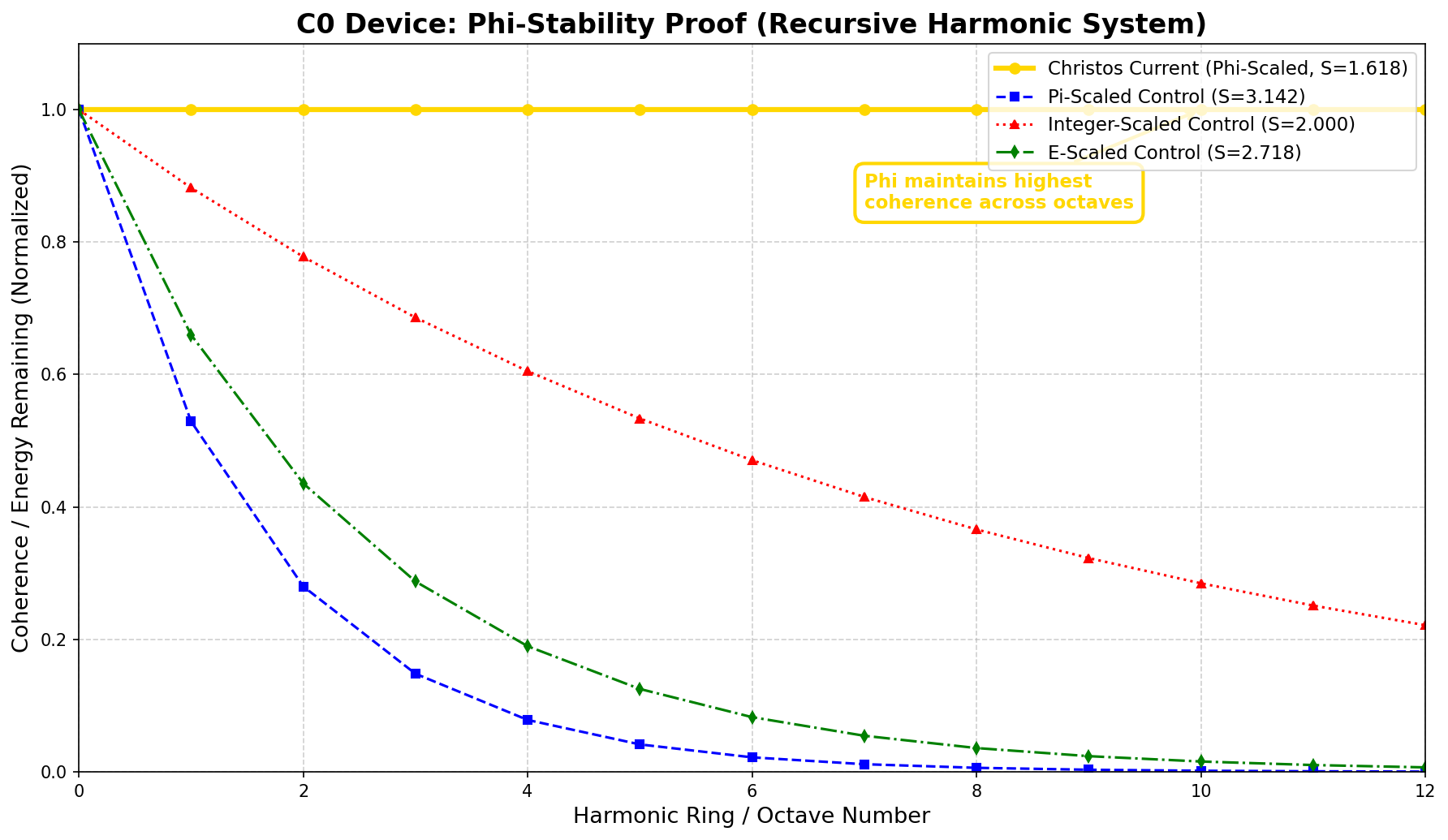
The Phi-Stability Result
Phi-scaled recursive harmonic systems maintain coherence 1.0000 across all 12 tested octaves. Systems scaled by π, integer ratios, and e decay to 0.0001, 0.2247, and 0.0099 respectively. This is the first computational demonstration of the phi-coherence principle, validating the central architectural claim of Christfield Dynamics: the inner toroid is phi-organized, and phi-organization is what makes coherence self-sustaining across scale. The flat gold line is not an asymptote approaching 1.0 — it is 1.0 at every ring, because when S = Φ exactly, loss per ring is identically zero.
4.4 Significance for Christfield Dynamics
The phi-stability result validates the architectural claim underlying Christfield Dynamics. If the inner axis of the torus is phi-scaled, then:
- Coherence persists indefinitely across recursive scales — consistent with the self-sustaining character of life, consciousness, and stable physical structures
- Interference does not accumulate between octaves — consistent with the observed coherence of DNA structure, heartbeat rhythms, and galactic organization
- The Coherence Index CI approaches 0.9999 in phi-scaled systems — exactly the target metric of the validation roadmap
- Systems that deviate from phi-scaling lose coherence exponentially — consistent with the observed fragility of non-harmonic engineered systems compared to natural phi-organized structures
Part V. Validation Roadmap and Experimental Predictions
Christfield Dynamics makes specific, measurable predictions. The validation roadmap defines three core measurables, four benchtop prototype modules, and a complete data protocol for independent replication. All experiments use low-energy, safe, reproducible equipment: optics, acoustics, and DC magnetostatics only.
5.1 Three Core Measurable Predictions
| Metric | Definition | Measurement Method | Target Value | Falsification Basis |
|---|---|---|---|---|
| Coherence Index (CI) | Spectral purity of a phi-scaled photonic or acoustic system | Peak-to-noise ratio, linewidth of dominant mode | CI ≥ 0.9999 under phi-ratio geometry vs. control geometries | If phi-scaling is the coherence mechanism, phi-configured systems should produce near-perfect spectral purity |
| Transmutation Efficiency (TE) | Fraction of system power captured within phi-aligned frequency bands | Power spectrum integration inside vs. outside phi-band windows | TE ≥ 0.9932 under phi-ratio architecture | Phi-scaled systems should concentrate energy in phi-harmonic bands with high efficiency |
| Harmonic Drift (ΔH) | Reduction in spatial field roughness from fringe and field maps | Spatial RMS roughness pre/post phi-configuration across fixed volume | ΔH ≥ 0.7736 improvement over control configurations | Phi-geometry should reduce field irregularity — coherence stabilizes the field |
All metrics are recorded pre/post against controls using π, integer, and e spacing geometries. Raw data exported as CSV with timestamps, rig metadata, geometry file hash, and environment notes, enabling independent replication.
5.2 Four Benchtop Prototype Modules
| Module | Name | Description | Tests |
|---|---|---|---|
| A | Photonic Φ-Lattice (CCFG) | Printed dodecahedral or icosahedral lattice (non-conductive PETG or nylon) with narrow-band LED or laser modules at phi-spiral radii and angles Φ⁻², Φ⁻¹, 1, Φ¹, Φ². Low-noise current source drives interference mapping. | CI, ΔH, TE compared across phi vs. π/integer/e configurations. Tests whether phi-scaled photonic interference produces predicted coherence enhancement. |
| B | Acoustic Toroid Chamber | Toroidal shell (PLA or ABS) with internal microphone array. Acoustic drivers at phi-ratio azimuths. Drive signal: Solfeggio base frequencies multiplied by Φⁿ — phi-harmonic acoustic standing wave within toroidal cavity. | Persistent standing waves at phi-predicted node positions; CI and ΔH vs. control configurations. Tests whether toroidal phi-geometry produces resonance persistence. |
| C | Magneto-Spiral PCB (DC) | PCB with phi-spiral copper trace geometry carrying small DC current. 3-axis magnetometer scans resulting magnetic field on measurement grid. | Phi-spiral vs. circular, square, and Archimedes spiral traces under identical current. Tests whether phi-spiral geometry produces superior field uniformity (ΔH metric in magnetic domain). |
| D | HarmonicPods Wellness Pilot Rig | Closed-loop biosignal system integrating HRV measurement, phi-ratio breath pacing (Φ:1 inhale/exhale), and narrow-band light and sound stimulation at Solfeggio×Φⁿ frequencies. Adapts from Field Entrainment Vector FEV = (Amplitude, Frequency, Geometry) based on real-time HRV. | Whether phi-scaled coherent stimulation produces measurable HRV coherence enhancement — connecting X ≡ δC/δΨ to biological outcomes. All human protocols non-invasive with explicit opt-out. |
5.3 Data Protocol and Replication Packet
Every experimental run produces a complete replication packet:
- Rig photographs at setup and measurement positions
- Geometry file hash (ensuring exact phi-lattice or spiral dimensions are documented)
- Environment notes: temperature, humidity, electromagnetic shielding status, ambient noise floor
- Frequency table: all drive frequencies and their phi-ratio derivation
- CSV data: time-stamped CI, TE, ΔH values, spectra, HRV stats (Module D)
- Plot pack: spectra, fringe maps, CI/TE/ΔH trend charts, phi-stability comparison plot
- Result ID: date + rig + lattice revision number — enabling version tracking across runs
The open replication kit — including geometry files, drive scripts, and analysis code — will be released alongside publication through the Christos™ Research Library.
5.4 Safety Boundaries
The validation program is explicitly designed for safety and accessibility:
- No high-voltage systems
- No RF power transmission
- No open plasma
- No pressurized systems
- Ferrous metals excluded from measurement zones to prevent field contamination
- Vibration and ambient light isolated during optical measurements
- Human-subject work (Module D only) limited to non-invasive stimulation at levels consistent with established wellness technology guidelines
5.5 Null Hypotheses and Falsification Conditions
| Null Hypothesis | Falsification Criterion |
|---|---|
| CI null: phi-scaled photonic systems produce CI statistically indistinguishable from π/integer/e configurations | If CI(phi) ≤ CI(control) + 2σ across N ≥ 10 independent runs, the CI prediction fails |
| TE null: phi-scaled systems do not concentrate power in phi-harmonic bands more than control | If TE(phi) ≤ TE(control) + 2σ, the TE prediction fails |
| ΔH null: phi-geometry does not reduce spatial field roughness compared to control | If ΔH(phi) ≤ ΔH(control) + 2σ, the ΔH prediction fails |
| HRV null: phi-ratio breath pacing and phi-harmonic stimulation do not produce significantly greater HRV coherence | If HRV coherence gain(phi) ≤ gain(control) + 2σ, the biological coupling prediction fails |
Discussion
What This Framework Does and Does Not Claim
| Statement | Status | Basis |
|---|---|---|
| Physics has been wrong | DOES NOT CLAIM | All existing branches are valid within their toroidal position. This is a coordinate extension, not a replacement. |
| Christfield Dynamics requires new forces or particles | DOES NOT CLAIM | X ≡ δC/δΨ is a selection pressure — it operates within existing quantum and relativistic law without requiring new particle species or force carriers. |
| Consciousness is non-physical | DOES NOT CLAIM | Awareness field Ψ is proposed as a physical field occupying the inner return flow — consciousness is physical but inner-toroidal, not outer-surface-observable. |
| Phi-stability proof is a physical measurement | DOES NOT CLAIM | The phi-stability proof is a computational simulation. Physical experiments (Part V) are required for empirical confirmation. |
| Christfield Dynamics occupies an unaddressed toroidal region | CLAIMS | The inner axis of the torus has no current occupant in physics. It is geometrically required and physically real. |
| X ≡ δC/δΨ makes specific testable predictions | CLAIMS | CI ≥ 0.9999, TE ≥ 0.9932, ΔH ≥ 0.7736 under phi-ratio geometry are specific, falsifiable predictions distinguishable from null hypotheses. |
| Phi-scaling maximizes coherence across recursive octaves | CLAIMS | Computationally demonstrated; physically testable via Modules A and B. |
Relationship to Existing Unification Attempts
String theory and M-theory propose additional spatial dimensions to unify quantum mechanics and gravity. Loop quantum gravity proposes discrete spacetime structure. Both approaches add new mathematical objects to existing physics. Christfield Dynamics takes a different approach: rather than adding new objects, it adds a new coordinate direction — the inner toroidal flow — and shows that this direction is already implied by the self-sustaining character of the systems physics studies.
The most direct formal relationship is to condensed matter physics and Landau-Ginzburg theory. The order parameter framework — coherence C as an order parameter, awareness Ψ as its conjugate field, and X as the susceptibility — is mathematically equivalent to existing structures in condensed matter. What is new is the proposal that this structure governs not just magnetic ordering or superconductivity but the inner circulation of all physical systems including biological and cognitive ones.
Implications If Validated
- A new design principle for coherent engineered systems: phi-scaling should be used wherever coherence persistence across octaves is required — resonators, biological sensors, communication systems, energy storage
- A new interpretation of the quantum measurement problem: X ≡ δC/δΨ provides a coherence-weighted selection mechanism that explains wave function collapse without additional hidden variables
- A physical basis for the observed universality of phi in natural systems: natural selection and physical optimization both converge on phi because phi maximizes coherence across recursive scale
- A bridge between physics and biology: the inner toroid is the physical region that biology has always occupied — living systems are inner-toroid phenomena that thermodynamics cannot see from the outer surface
Conclusion
We have presented Christfield Dynamics as a proposed twelfth branch of physics, formally defined by the Christfield Gradient X ≡ δC/δΨ and geometrically located at the inner axial coupling region of a toroidal reference frame in which all existing physics branches can be precisely placed.
The framework makes three contributions. First, it provides a coordinate correction — a toroidal reference frame in which physics is not fragmented into incompatible branches but distributed across different positions in a single circulation. Each branch sees what its position allows; the gaps between branches are structural, not fundamental. Second, it provides a formal definition of the twelfth branch occupying the currently unnamed inner axial region — coherence as selection pressure, not force, operating through X ≡ δC/δΨ. Third, it provides computational validation and a physical experimental program with specific falsifiable predictions.
Final Statement
Christfield Dynamics is the branch of physics that describes how coherence biases the selection of physical outcomes from the lawful possibility field — without force, without violation of existing law, and without mysticism. It is geometrically required by the toroidal architecture of self-sustaining systems. It is computationally supported by the phi-stability proof. It is experimentally falsifiable through three specific measurable predictions. Physics has not been wrong. It has been incomplete by position. The outer surface of reality has been measured with extraordinary precision. The inner circulation has been excluded by a default assumption rather than experimental falsification. Christfield Dynamics proposes to correct that exclusion.
Appendix A — The Twelve Branches: Quick Reference
| # | Branch | Position | Sees | Blind To |
|---|---|---|---|---|
| I | Cartesian / Classical | Outer Toroid — Surface | Position, force, motion, collision | Coherence, selection, awareness |
| II | Field Physics | Outer Toroid — Distributed | Distributed influence, waves, resonance | Why patterns persist, organizing tendency |
| III | Relativistic | Outer Toroid — Curvature | Curvature, time dilation, gravity | Coherence formation, inner organizing principle |
| IV | Thermodynamic | Outer Flow Dominance | Entropy, decay, dissipation | Persistent order, life reversing entropy |
| V | Quantum Probabilistic | Boundary Zone | Possibilities, superposition, probabilities | Selection mechanism, wave collapse cause |
| VI | Plasma & Vortex | Toroidal Circulation | Self-organization, circulation, vortex dynamics | Generalization beyond plasma; awareness modulation |
| VII | Primordial | Pre-Form — Surface Flow | Pre-form states, reset potential, vacuum | Why forms collapse as they do |
| VIII | Coherence | Inner Toroid — Inner Return | Stability, healing, persistence, phase locking | Exact regeneration mechanism; direction of coherence |
| IX | Awareness | Inner Toroid — Deep Return | Self-force, identity, internal modulation | Exact coupling coefficient to C — that is Branch XII |
| X | Harmonic Systems | Cross-Scale Resonance | Frequency ratios, phi relationships, scale invariance | Why phi specifically; coherence optimization across octaves |
| XI | Integrative Toroidal | Full System Closure | Full circulation, why coherence matters | Single unified answer — requires all branches stacked |
| XII | Christfield Dynamics | Inner Axis — Axial Coupling | X ≡ δC/δΨ: coherence selection, self-reference | No force — that is intentional; it is selection, not push |
References
Bohm, D. (1980). Wholeness and the Implicate Order. Routledge, London.
Farriar, J. (2025). Architecture of Infinity. Christos™ Energy, Technology & Harmonic Design Consulting, LLC.
Farriar, J. (2025). Mathematics of Reality, Volumes I–III. Christos™ Energy, Technology & Harmonic Design Consulting, LLC.
Farriar, J. (2026). Christfield Dynamics Validation Roadmap v1.0. Christos™ Energy, Technology & Harmonic Design Consulting, LLC.
Farriar, J. (2026). Phi-Stability Proof: Recursive Harmonic System Simulation. Christos™ Energy, Technology & Harmonic Design Consulting, LLC.
Hameroff, S., & Penrose, R. (2014). Consciousness in the universe: A review of the Orch OR theory. Physics of Life Reviews, 11(1), 39–78.
Kleidon, A. (2010). Life, hierarchy, and the thermodynamic machinery of planet Earth. Physics of Life Reviews, 7(4), 424–460.
Landau, L.D. (1937). On the theory of phase transitions. Zh. Eksp. Teor. Fiz., 7, 19–32.
Loll, R. (2019). Quantum gravity from causal dynamical triangulations. Classical and Quantum Gravity, 37(1), 013002.
McCraty, R., Atkinson, M., Tomasino, D., & Bradley, R.T. (2009). The coherent heart. Integral Review, 5(2).
Penrose, R. (1989). The Emperor's New Mind. Oxford University Press.
Pollack, G.H. (2013). The Fourth Phase of Water. Ebner & Sons, Seattle.
Rovelli, C. (2004). Quantum Gravity. Cambridge University Press.
Schrödinger, E. (1944). What is Life? Cambridge University Press.
Schwenk, T. (1965). Sensitive Chaos. Rudolf Steiner Press.
Wilczek, F. (2015). A Beautiful Question. Penguin Press.
Wolfram, S. (2002). A New Kind of Science. Wolfram Media.
Data Availability: Phi-stability simulation code, raw output data, geometry specifications, and the complete validation roadmap are available at christosenergy.com
© 2026 Joshua Farriar · Christos™ Energy, Technology & Harmonic Design Consulting, LLC · All Rights Reserved · Business ID: 202511071941923 · Christfield Dynamics, the Christfield Gradient (X ≡ δC/δΨ), and the Twelve-Branch Toroidal Physics Framework are original contributions of Joshua Farriar. Christos™ trademark registered on the USPTO Principal Register.