Part of an Eight-Volume Set
This is the sixth of eight detailed volume pages expanding on [[planetary-stewardship-transducer]] (AW-04). Where [[pst-104-controls-automation]] (AW-13) defined the automation architecture, the PLC, I/O, and control philosophy, PST-106 defines the platform's physical senses: every sensor, the instrumentation network that connects them, and the layered functional safety, cybersecurity, digital twin, and bounded AI supervision built on top of them. This is the largest of the eight volumes, 19 chapters against roughly 12 in the others, so this page covers it at correspondingly greater length.
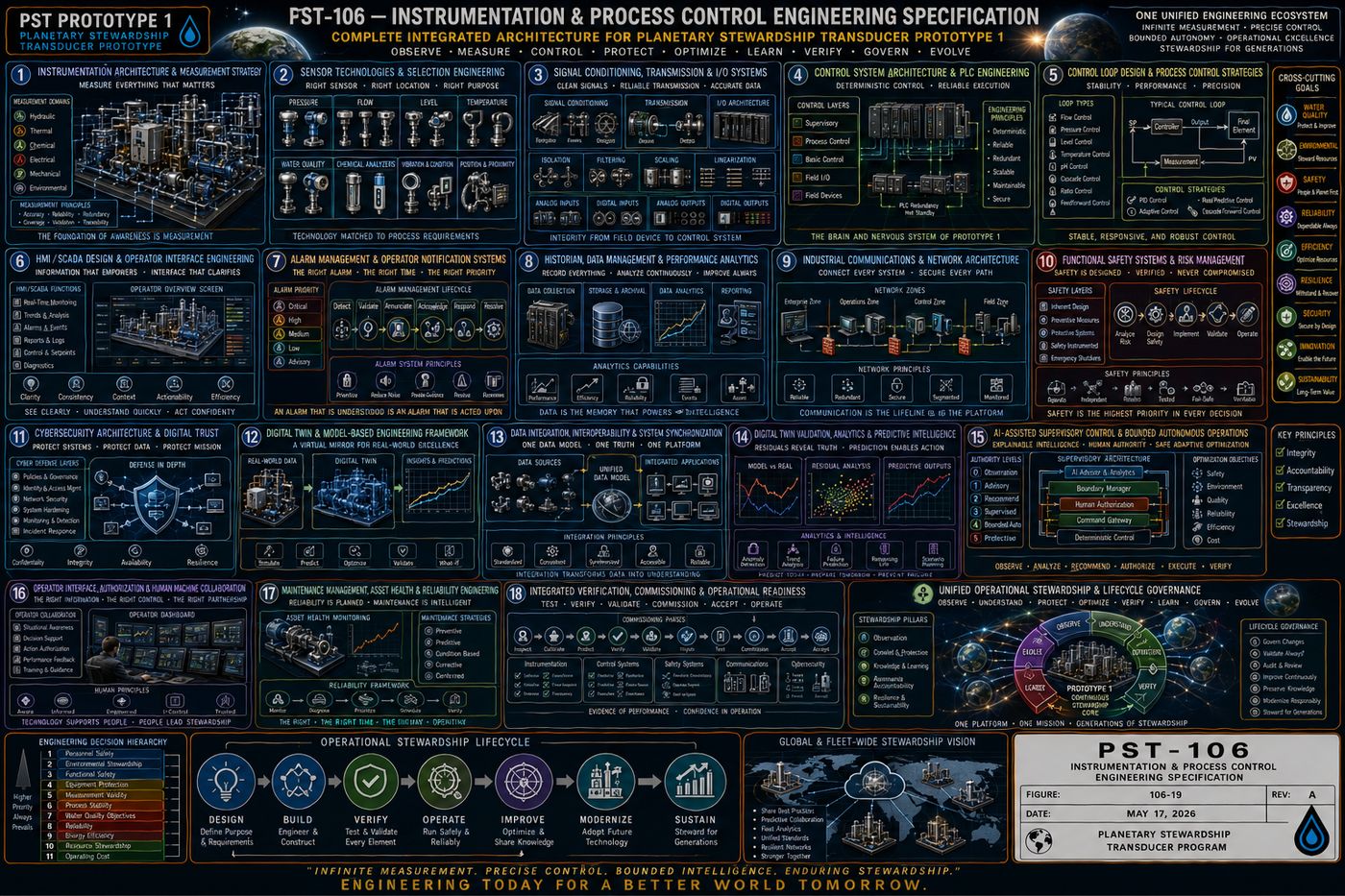
PST-106 defines the complete instrumentation and process control architecture of Prototype 1: the philosophy governing every measurement, the seven measurement disciplines (pressure, flow, temperature, level, analytical water quality, vibration and mechanical condition, and electrical power), the process control loops that turn measurement into action, the layered industrial communications network, the historian that preserves the platform's permanent operational memory, alarm management and the human-machine interface, the independent functional safety layer, the defense-in-depth cybersecurity architecture, the digital twin that mirrors the physical machine, the bounded and human-governed AI supervisory layer, the integrated commissioning program, and the closing philosophy of unified operational stewardship.
All nineteen chapters are covered below, following the specification's own structure: purpose, engineering intent, philosophy, architecture, and a chapter summary. Given the volume's size, the seven measurement-discipline chapters and the two largest chapters, functional safety and cybersecurity, are covered at a summary level appropriate to a public overview, with their full subsection-by-subsection detail reserved for the protected engineering package.
I. Instrumentation Philosophy and Process Measurement Architecture
Instrumentation transforms physical phenomena into reliable engineering information: every measurement acquired by the platform becomes the foundation upon which automation, diagnostics, optimization, safety, and maintenance depend, so the instrumentation system is engineered as a primary subsystem of Prototype 1 rather than an accessory to automation. Every sensor has a clearly defined engineering purpose, and every measured value supports one or more operational objectives; measurements are never collected simply because they are available. Measurements flow through a structured information hierarchy, physical process, sensor detection, signal conditioning, controller interpretation, engineering information, operational decision, historical knowledge, and continuous improvement, with each stage increasing the engineering value of the original measurement.
Rather than viewing sensors independently, the process measurement architecture integrates information from every discipline, hydraulic, mechanical, electrical, thermal, structural, environmental, and analytical, into a coherent operational model. Measurements are organized by engineering function into a hierarchy running from primary process variables (flow, pressure, temperature, level, water quality) through equipment health variables (vibration, bearing temperature, motor current) and structural variables to derived engineering variables like efficiency and predictive maintenance indicators, with each successive layer transforming raw measurement into progressively more valuable engineering knowledge. Information is prioritized across five levels, from Level 1 critical protection through Level 5 historical knowledge, ensuring engineering attention stays focused on the most consequential information, and all field instrumentation connects through a structured network, field sensors, signal conditioning, distributed I/O, PLC controllers, historian, and operator interface, prioritizing reliability, scalability, and maintainability. The architecture is designed to remain adaptable as sensing technology advances, smart digital sensors, fiber-optic sensing, and distributed sensing networks, without disrupting the original measurement architecture.
II. The Seven Measurement Disciplines
Pressure, flow, temperature, level, and electrical power measurements share a common engineering pattern throughout the specification: each discipline defines its own instrument types, measurement range selection, installation practices, diagnostic applications, calibration philosophy, alarm strategy, and lifecycle management, applied consistently across the platform.
2.1 Pressure Measurement
Pressure is monitored at every critical hydraulic point, raw water intake, pump suction and discharge, filter inlet and outlet, and distribution manifolds, using gauge, absolute, differential, and smart digital transmitters selected according to process requirements and required accuracy. Differential pressure across filtration systems, strainers, and treatment modules supports predictive maintenance by identifying gradual performance degradation before operational limits are reached, and pressure trends support diagnostics including cavitation detection, pump degradation, filter loading, and leak detection.
2.2 Flow Measurement
Flow is measured at raw water intake, pump discharge, filtration inlet and outlet, treatment modules, and distribution manifolds, quantifying water movement to support process balance, equipment performance evaluation, treatment verification, and resource accountability, with instrumentation providing complete visibility of water movement through the platform.
2.3 Temperature Measurement
Temperature is treated as both a process variable and an equipment-health indicator, monitored at process-fluid locations, pump bearings, motor windings, and electrical cabinets to protect equipment, support treatment-process verification, compensate temperature-sensitive measurements, and enable predictive maintenance through historical thermal-performance trending.
2.4 Level Measurement
Level instrumentation provides continuous awareness of fluid inventory and containment conditions, treated as both a process variable and a containment-safety variable. Measurement locations span raw-water intake reservoirs, buffer and suction tanks, treatment chambers, chemical dosing tanks, sumps, and spill-containment areas, supporting pump protection, overflow prevention, dry-run prevention, and inventory accounting. Critical protective functions do not depend solely on a single unverified measurement where failure could damage equipment or release fluid.
2.5 Analytical Water Quality Measurement
Unlike pressure, flow, temperature, and level, analytical sensors measure the condition of the process fluid itself rather than the mechanics of transporting it, continuously evaluating chemical and physical properties, pH, oxidation-reduction potential, conductivity, dissolved oxygen, and turbidity, at raw-water intake, intermediate treatment stages, and final discharge. These measurements verify treatment effectiveness, detect contamination, control dosing systems, and support regulatory verification, with sensor fouling, cleaning, and temperature compensation treated as first-class engineering concerns rather than afterthoughts.
2.6 Vibration and Mechanical Condition Monitoring
Vibration instrumentation provides continuous awareness of the dynamic condition of pumps, motors, bearings, shafts, couplings, and structural frames, treated as engineering evidence of mechanical condition rather than as a simple alarm variable. Monitoring supports early fault detection, bearing protection, shaft and coupling diagnostics, cavitation identification, and alignment verification through time-waveform analysis, frequency-spectrum analysis, and envelope analysis, allowing the platform to detect deterioration while equipment remains operational and before functional failure occurs.
2.7 Electrical Power and Energy Monitoring
Electrical monitoring provides continuous awareness of the health, stability, efficiency, and quality of the electrical systems energizing the platform, incoming service, distribution panels, motor control centers, variable-frequency drives, and instrumentation power supplies, representing both the condition of the electrical supply and the behavior of connected equipment, supporting equipment protection, energy optimization, motor diagnostics, and power-quality verification.
Protected — Full Measurement-Discipline Detail
Each of the seven measurement disciplines above runs to 13–32 subsections in the full specification, covering exact instrument types, measurement ranges, installation practices, calibration procedures, and alarm setpoints in complete technical detail. That full detail is reserved for the protected engineering package.
III. Process Control Loops and Automatic Control Systems
Automatic control transforms instrumentation into coordinated operational decisions: sensors provide awareness, the control system provides action, together creating a platform capable of continuously maintaining stable operating conditions despite changing process demands. Control actions are always explainable, traceable, and reversible, and no automatic action relies on a single unvalidated measurement where equipment protection or environmental stewardship could be compromised.
Every control loop consists of four elements, measurement, controller, final control element, and process response, forming a closed feedback loop, and Prototype 1 supports both feedback control, responding to measured deviations after they occur, and feedforward control, responding to predicted disturbances before they affect the process, combined where practical to improve stability and response time. Every loop supports defined operating modes, manual, automatic, cascade, ratio, supervisory, maintenance, and emergency override, with mode transitions designed to be smooth and avoid unnecessary process disturbances. The architecture recognizes that many process variables interact, flow versus pressure, level versus pump speed, and coordinates these relationships to prevent one loop from degrading another, and automatic equipment sequencing coordinates startup, operation, shutdown, and maintenance through documented permissives, interlocks, timeout conditions, and fault recovery procedures. The control system continuously evaluates the health of every loop, sensor disagreement, saturated actuators, valve stiction, and communication faults, with control-loop performance periodically benchmarked against commissioning baselines.
IV. Industrial Communications and Control Network Architecture
The communications architecture provides the digital nervous system connecting sensors, controllers, operator interfaces, historians, analytical systems, and future autonomous platforms, treated as a critical engineering asset rather than simple information technology. Reliable communications ensure every measurement, command, alarm, and diagnostic event is delivered accurately, securely, and within required time constraints.
Prototype 1 employs layered communication networks according to operational criticality, field instrumentation, local control, supervisory control, engineering workstations, historian systems, and enterprise integration, each engineered to meet its required performance, reliability, and security objectives. The architecture consists of interconnected but logically separated network segments, a field device network connecting sensors and actuators directly, and progressively broader supervisory and enterprise layers above it, supporting deterministic control communications, real-time monitoring, and future digital-twin and AI-assisted integration while protecting operational cybersecurity throughout.
V. Process Historian, Data Management, and Operational Intelligence
The historian serves as the permanent operational memory of the platform, continuously collecting, organizing, validating, preserving, and presenting process information generated throughout the instrumentation and control system. It preserves not only what occurred, but when it occurred, why it occurred, and how the platform responded, becoming a continuously expanding engineering reference for the complete operational life of Prototype 1.
Every meaningful operational event becomes part of the permanent engineering record, process variables, equipment status, alarm activity, operator actions, setpoint changes, and calibration records, remaining searchable, traceable, and synchronized across all engineering systems. Historical information supports engineering investigations, predictive maintenance, process optimization, equipment performance benchmarking, regulatory documentation, digital-twin development, and future AI-assisted analytics, transforming raw operational history into a growing engineering asset rather than a static log.
VI. Alarm Management and Operator Interface Systems
The alarm-management system ensures abnormal operating conditions are detected, classified, communicated, acknowledged, documented, and resolved in a consistent, engineering-driven manner, while the operator interface transforms complex instrumentation and control information into intuitive operational awareness. An alarm is not merely an indication that a value has changed: it indicates that an abnormal condition exists, that operator action is required, or that automatic protective action has occurred, and information that requires no action is never configured as an alarm.
Alarms are classified according to operational consequence, and the alarm lifecycle, including suppression and shelving during known conditions, prevents nuisance notification from eroding operator trust in the system. The HMI philosophy presents information according to operational importance rather than engineering complexity, with a defined display hierarchy, standardized graphical conventions, and active operator guidance, recommended corrective actions and troubleshooting workflows, serving as an engineering assistant rather than simply an information display. Alarm-flood prevention and historical alarm analysis together transform the alarm system into an engineering resource that improves over time rather than a static list of thresholds.
VII. Functional Safety, Interlocks, and Emergency Shutdown Systems
Functional safety systems provide an independent layer of protection when normal process control, equipment control, operator response, or communications fail to maintain acceptable operating conditions, engineered as a distinct protective layer rather than an extension of normal process control. Prototype 1 employs multiple layers of protection, inherent design safeguards, normal process control, equipment interlocks, alarm and operator response, independent shutdown logic, mechanical relief, and emergency response procedures, with no single protective layer assumed to eliminate every hazard. Where a hazardous condition can develop rapidly, automatic protection never depends solely on operator recognition and intervention.
Every protected subsystem has a documented safe state, which does not always mean complete de-energization; maintaining ventilation, drainage, or selected circulation may be required to preserve safety. A protective function consists of an initiating sensor, a logic solver, a final protective element, and feedback verification confirming the protective action occurred, with every element documented and testable. Permissives prevent equipment from starting unless required conditions are satisfied, preventing unsafe startup rather than waiting for a trip after operation begins, and interlocks automatically coordinate equipment behavior when process conditions change, clearly distinguished from normal control commands. The Emergency Shutdown System provides rapid, predictable platform protection, stopping process pumps, disabling chemical dosing, closing incoming valves, and isolating electrical loads in an engineered sequence that avoids creating secondary hazards, and emergency-stop devices are clearly visible, mechanically latched, and manually reset, with software commands alone never serving as the only means of emergency stopping where direct protective action is required. The chapter's full technical detail extends through voting logic, sensor independence, logic solver architecture, de-energize-to-trip philosophy, proof testing, common-cause failure prevention, and post-trip review, establishing that normal control allows the machine to operate while functional safety ensures it knows how to stop.
VIII. Industrial Control System Cybersecurity
The cybersecurity architecture protects the confidentiality, integrity, availability, authenticity, and traceability of every digital system responsible for sensing, controlling, protecting, documenting, and optimizing the platform, treated as an operational engineering discipline rather than a separate office-information-technology function. Prototype 1 employs defense-in-depth: no single firewall, password, encrypted connection, or monitoring system is assumed to provide complete protection, and the design assumes individual protective controls may eventually fail, preventing one failure from compromising the entire platform.
The platform is divided into logical and physical security zones of progressively broader trust, from Zone 1 (safety systems, receiving the highest isolation and access control) through the process control network, instrumentation network, supervisory and historian network, an industrial demilitarized zone, and finally enterprise and external systems, with direct uncontrolled communication between enterprise systems and critical control devices never permitted. Communication between zones occurs only through defined, documented conduits, and the architecture combines secure physical design, network segmentation, device authentication, role-based access, controlled engineering access, continuous monitoring, configuration management, backup and recovery, and incident response into a single coordinated program. The full chapter, the specification's longest, extends through device identity, PLC and safety-system protection, remote access, wireless security, patch management, intrusion detection, anomaly detection, incident response, forensic evidence preservation, supply-chain security, and personnel training, establishing that instrumentation tells the platform what is happening, control tells it how to respond, and cybersecurity ensures the measurements, commands, identities, and records used to make those decisions can be trusted.
IX. Digital Twin, Advanced Analytics, and Model-Based Operations
The digital twin provides a synchronized virtual model of the physical platform, combining engineering design information, equipment characteristics, real-time measurements, historical data, control-system status, and predictive models. It is explicitly not treated as a decorative three-dimensional model; it functions as a validated engineering representation tied directly to measurable physical reality, with every model carrying a clearly defined purpose, data source, accuracy requirement, validation status, and responsible engineering owner.
The digital twin is developed as a hierarchy of interconnected models rather than one universal simulation, a physical asset model, an instrumentation model, hydraulic, thermal, electrical, mechanical condition, water-quality and treatment, control-system, and safety-response models, each operating independently while exchanging information through a common data architecture. The twin supports residual analysis and anomaly detection, comparing measured performance against expected performance; predictive analytics and what-if simulation, testing operating changes before physical implementation; virtual commissioning and operator training; and model governance including explainability and human authority over any optimization the model suggests. The digital twin does not replace the physical machine; it gives the physical machine a continuously updated engineering mirror through which its behavior can be understood, tested, predicted, and improved.
X. AI-Assisted Supervisory Control and Bounded Autonomous Operations
The purpose of the autonomous-operations architecture is explicitly not to remove engineering authority. Its purpose is to allow the platform to perform clearly defined, repeatable, validated actions more consistently, rapidly, and intelligently while preserving human oversight, functional safety, cybersecurity, and complete traceability. No AI system possesses unlimited authority over Prototype 1; every automated function operates within explicitly defined engineering boundaries, and AI functions as an additional analytical and supervisory layer positioned above validated instrumentation, control, safety, and cybersecurity systems, never replacing independent safety systems, hardwired emergency shutdown, validated protective interlocks, or required operator authority.
10.1 Six Levels of Operational Authority
| Level | Function |
|---|---|
| 0 — Observation Only | Collects data and identifies patterns; produces no recommendation and executes no action |
| 1 — Advisory | Provides diagnostic observations, probable causes, and suggested investigation steps; no control action is prepared or executed |
| 2 — Recommended Action | Proposes a specific operational action (for example, reduce pump speed, initiate a filter inspection); the operator must review and initiate it |
| 3 — Supervised Execution | Prepares an approved control action but requires human authorization before execution, showing the proposed action, supporting evidence, expected result, and reversal method |
| 4 — Bounded Autonomous Optimization | May adjust approved process variables automatically within predetermined limits (minor pump-speed adjustment, dosing trim, equipment rotation), constrained by validated limits and deterministic protective logic |
| 5 — Independent Protective Action | Explicitly belongs to the functional-safety architecture, not general AI supervision; AI may identify developing risk, but emergency trips remain governed by formally validated protective systems |
The full authority hierarchy runs instrumentation through PLC control, the digital twin, an AI advisor, a decision-boundary manager, human authorization, a validated command gateway, and finally physical action, with every proposed action passing through explainability requirements, confidence scoring, and a command-validation gateway before execution. Closed-loop verification and automatic rollback confirm that any autonomous action produced its intended result and can be reversed if it did not, and the chapter's remaining technical detail covers autonomous pump optimization, chemical dosing optimization, model drift detection, adversarial and corrupted data handling, and shadow-mode commissioning, where new AI capability runs alongside the operator without control authority until proven reliable. The objective is not an uncontrolled machine making its own decisions; it is a deeply instrumented platform capable of performing approved actions intelligently, transparently, and safely within boundaries established by its human stewards.
XI. Integrated Verification, Commissioning, and Operational Readiness
Integrated commissioning confirms that every individual component performs correctly and that all components function together as one coordinated operational system, with operational readiness demonstrated through evidence rather than assumed from construction completion. The program distinguishes verification, was the system built correctly according to the approved design, from validation, does the completed system perform its intended operational function, with both required before acceptance.
Commissioning proceeds through a twenty-stage structured hierarchy: documentation review, construction inspection, mechanical and electrical completion, instrument verification, point-to-point signal testing, control-system configuration verification, loop checking, equipment functional testing, interlock testing, safety-system validation, network and historian testing, dry sequence testing, wet process commissioning, integrated performance testing, digital-twin validation, AI shadow-mode commissioning, operational-readiness review, formal handover, and post-startup stabilization, with each stage carrying defined prerequisites and acceptance criteria. Successful commissioning concludes with a formal handover package, as-built documentation, calibration records, safety validation, cybersecurity documentation, digital-twin models, AI model versions, and operator qualifications, becoming the foundational engineering record supporting the platform's entire operational life. Prototype 1 is considered operational not when construction ends, but when measurable evidence demonstrates that every subsystem performs safely, reliably, and together as a unified platform.
XII. Unified Operational Stewardship and Lifecycle Governance
The closing chapter of PST-106 does not introduce another subsystem; it unifies everything into a single operational philosophy. Prototype 1 is not viewed as a collection of independent technologies. It is managed as one continuously evolving engineering ecosystem, continuously observing its physical, operational, electrical, hydraulic, environmental, digital, cybersecurity, safety, and maintenance condition, since observation alone is insufficient: each observation must become engineering understanding, and engineering understanding must support informed action.
Operational decisions follow a defined, non-negotiable hierarchy: personnel safety first, then environmental stewardship, functional safety, equipment protection, measurement validity, process stability, water-quality objectives, reliability, energy efficiency, resource stewardship, and finally operating cost, with lower-priority objectives never permitted to compromise higher-priority responsibilities. Operational excellence is maintained through structured improvement drawing on historian trends, maintenance records, alarm analysis, and AI recommendations, with every improvement kept measurable, documented, validated, and reversible where practical, and engineering changes follow controlled governance, no undocumented change becomes part of the operational platform. The platform preserves engineering knowledge through design documentation, commissioning reports, incident investigations, and training materials, ensuring future engineers inherit understanding rather than merely equipment, and remains resilient against equipment failure, cybersecurity incidents, and human error through layered engineering rather than reliance on any single technology. The platform is expected to become progressively more valuable as operational knowledge accumulates.
Protected — Detailed Engineering Package
Exact instrument models and calibration ranges for all seven measurement disciplines, safety instrumented function trip setpoints and voting logic, the complete cybersecurity zone and conduit architecture, digital twin model validation data, AI decision-boundary parameters, and the full commissioning test procedure library are held under NDA pending requirements freeze and physics validation, consistent with the source specification's own stated pre-construction status.
Full Specification Available Under Signed NDA ↗Documentation Summary
The instrumentation philosophy and measurement architecture, the seven-discipline measurement framework, the control loop architecture, the layered communications network, the historian architecture, the alarm management and HMI framework, the multi-layer functional safety architecture, the defense-in-depth cybersecurity zone architecture, the twelve-layer digital twin model hierarchy, the six-level bounded AI authority framework, the twenty-stage commissioning sequence, and the unified operational stewardship philosophy are original work product of Joshua Farrior, developed under CHRISTOS™ Energy, Technology & Harmonic Design Consulting, LLC.
Held under NDA pending further development: exact instrument models, ranges, and calibration procedures for every measurement discipline; safety instrumented function trip setpoints, voting logic, and proof-testing schedules; the complete cybersecurity zone, conduit, and access-control configuration; digital twin model validation datasets and accuracy bounds; AI decision-boundary parameters and optimization objective weightings; the complete engineering drawing package; the bill of materials; and commissioning test procedures beyond the twenty-stage sequence described above.
© 2026 Joshua Farrior · Christos™ Energy, Technology & Harmonic Design Consulting, LLC · All Rights Reserved · Business ID: 202511071941923 · Christos™ trademark registered on the USPTO Principal Register · christosenergy.com